Showing posts with label marketing. Show all posts

Sunday, 29 July 2007

Don't Judge A Book By Its Cover

They say don’t judge a book by its cover; so why do the Harry Potter books have separate child and adult covers?
The phenomenal success of J.K. Rowling’s boy wizard series has meant that the Harry Potter debate is no longer relevant. The books are now read by such a large audience that they have become as much a part of contemporary popular British culture as Big Brother.
The debate was that Harry Potter is clearly a children’s book and therefore should only be read by children. ‘Aah, but adults can read it too!’ cried the slightly embarrassed legal drinking age fans of the series. This in itself was a baffling statement; because of course adults can read children’s books. An adult can read Spot Says Woof perfectly easily but it doesn’t make it OK for them to shamelessly display it in public. ‘Well, Harry Potter’s quite dark you know’ they responded. As if to legitimise its adult readership, each book is heralded as being ‘the darkest one yet’. Of course this is all relative – get a Harry Potter fan to read a chapter of American Psycho and them let them say which one is darker.
However, the merits of reading Harry Potter are no longer debatable. Despite a large part of its (mainly young) audience seeing the series as an escape to another world and a symbol of individuality; it is conversely a symbol of conformity. This is why so many readers of the book proudly display their copy of the novel in public. There they sit, on trains or on park benches, proudly holding copies of their new book, like a teenage boy wearing his club’s new home shirt. It is a statement that says ‘I am part of something popular, I am part of something that is now, I am part of IT’.
So why are there separate adult and child covers for the book? The reason for there being alternative covers is, quite frankly, baffling. Yet at the same time it is a stroke of marketing genius. The buyers of the adult cover are, unsurprisingly, adults; keen to display to the surrounding public that what they are reading is an acceptable adult’s book. This of course, totally misses the point.
Everyone knows that it is a children’s book and almost everyone (including this once cynical writer) accepts that it’s perfectly OK for adults to read the novel. Yet the marketing people at Bloomsbury know that the general public cannot help but to judge someone/something on its appearance and this is why the adult covers are published. So buyers of the adult cover are arguably buying the book for its status as much as they are for its content. The very fact that the adult cover may actually outsell the children’s edition says something about our society. It says that it seems that millions of people, quite literally, do judge a book by its cover.

Saturday, 14 July 2007

Music as a Commodity

The latest indie rock compilation has declared itself ‘the only album you'll need to buy this year'. So just where does music stop being an art form and start becoming a commodity?
Art and commerce have a very intimate yet separate relationship with each other. Like illicit lovers there is a feeling of wrongdoing, yet they rely on each other for their own existence. Artists pour their creative heart and soul into making an object of art; yet that object (and the future creative life of the artist) is essentially worthless unless someone wants to buy it.
Essentially creativity is measured in terms of commerce; for artists it is the monetary value of their work; for musicians it is record sales. Without a product to sell the music industry wouldn’t be able to function. Without record companies to finance their musical creations, bands would not be able to exist; not in a full-time rock ‘n’ roll way, anyway. Therefore a delicate balance has always been struck between the artists and the companies that bankroll their creativity. Artists naturally want creative freedom and likewise record companies want a large return for their investment.
Now the internet is changing that balance as artists are free to give their music away and promote themselves online. A popular example of the MySpace music revolution is Lilly Allen; yet she was only able to properly play the game by signing for Parlophone, a major record label. Today it seems like everyone has a copy of the Lilly Allen album; her modern and cool take on catchy pop music appeals to NME teenagers and Q reading dads alike.
In the recent and excellent final episode of the Seven Ages Of Rock series, Noel Gallagher admitted that it wasn’t until ‘the squares’ started buying (What’s the Story) Morning Glory? that he became seriously rich. ‘The squares’ are the people who buy one record a year. Lilly Allen has sold so many copies of her debut album because her music has appealed beyond the music magazine reading fans; last year her album was the one that people who only buy one album a year bought.
For the single album buying public there is a hole in the market. If they just buy one album by the year’s biggest “alternative” act then they end up missing out on all of the songs that they hear on mobile phone and car adverts. This hole is filled by the compilation album; the major record label executive’s wet dream: a collection of hits that is directly aimed at the Chris Moyles listening masses.
The latest in a long line of indie rock compilation albums is the simply titled Just Great Songs. Now there’s a product that promises to do what it says on the tin; a collection of 40 songs that all the family can listen to. On the promotional advert Jamie Theakston enthusiastically exclaims that it’s ‘the only album you’ll need to buy this year’. Not that this is a collection of great songs, but it’s the only album that you (the annual solo album buyer) will need to buy this year. Essentially it is a perfect example of music being a commodity; something that is produced on a large scale in exchange for money. Therefore by packaging a song with a group of others as an item for monetary exchange, it ceases to be a work of art. Compilation albums therefore represent the ultimate example of the commodification of music.
But their large sales mean increased funds for the artists on the album, thus meaning that they can carry on creating music that will be potentially loved by an audience of millions. And at the end of the day that’s what every musician wants. 99% of the unsigned bands on MySpace Music aren’t on there so that they can give their music away for free. Like Lilly, they hope that their music will reach a large audience and they’ll get a record deal. Being on a compilation album might not be an aim, but it does signify that you’ve made it.

Tuesday, 9 May 2006

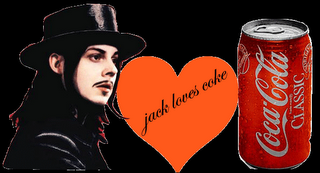
Jack and Coke


Indie icon and musical maverick Jack White has shocked many of his fans by recording a song for Coca-Cola. So has the flag-bearer of logo-free rock music really sold out?

“Do a commercial and you’re off the artistic roll-call forever. Every word you say is suspect. You are just another corporate whore at the capitalist gang bang.” Bill Hicks
“Madonna drinks Coke and so you can too, tastes real good not like a sweet poison should.” Manic Street Preachers
McDonalds had Justin Timberlake and Loving It. Now Coca-Cola has Jack White and Love is the Truth. McDonalds and Coca-Cola: two all-conquering multinationals synonymous with the dark side of capitalism. This is why the man who once rejected a deal to appear in a Gap advert has surprised so many of his fans by composing a song for the ‘sweet poison’ that is Coke.
The reason he has given for recording the song may surprise fans even more than hearing that The White Stripes front man had agreed to the deal. Jack has confessed that he loves Coke and this is why he agreed to write a song for one of their commercials. He loves it so much that he has declared it “the greatest drink ever made by man”. He is also a long term Coke fanatic, having reportedly written over 100 songs in celebration of the fizzy drink when he was a teenager.
Many have been quick to criticise the musician, but remember this is Jack White we are talking about here. He is a man who is dripping with mystery and a man who is, to say the least, unconventional. So unconventional in fact that he sees nothing wrong with writing a song for a drink that is a symbol of conformity?
It is not as if he has sold a song from his back catalogue for an advertisement, a la Moby. All 18 tracks of the vegan's 1999 album Play have featured in various commercials. The White Stripes singer defended his decision to record the song in an interview with N.M.E: "I've been offered the opportunity to write a song in a way which interests me as a songwriter. I certainly wouldn't want a song that I'd already written to be used on a commercial".
It has been pointed out that The White Stripes’ colours of red and white are the same colours as…you’ve guessed it. So was this bold tribute to simplicity really influenced by the colours of the most famous soft drink brand of all time? We may never know. But before some of his fans call for his head, we should give Jack White some leeway. Yes, he has written a song for a commercial, but it is for a drink that has reportedly had some influence in his life. So no Coke, no Jack, not as we know him, anyway.
So we will forgive him for now. But like the drink that he is singing about, it is still likely to leave a bitter-sweet taste in the mouths of his fans.

Thursday, 6 April 2006

Stupid Corporate Names

How the privatisation of British industries has led to a surge of companies with pointless names, who make promises that are as empty as their own titles.
Two words: British Rail. It’s pretty obvious what that stands for. Even for someone with the briefest command of the English language, it wouldn’t take them long to work it out.

What then, does One or First Capital Connect stand for? Not so obvious; perhaps a bank or some other kind of financial service? Well, One and First Capital Connect are actually the train companies that this writer regularly uses.


First Capital Connect: A bank account or a railway company?


I say I “use them”, but I’m sure that they would say that I “facilitate their services” or something as equally pretentious or pointless as that. Indeed, witness these gems from the First Capital Connect website:

  • ‘…a new company bringing fresh ideas and a determination to improve your journey experience’

  • ‘we see the new franchise as an opportunity to develop real, tangible benefits for customers across the board’

  • ‘…deliver the levels of customer service that will transform your journey experience’

Not only are they promising to ‘improve my journey experience’ they say that they will ‘transform it’ too. And as for the ‘real, tangible benefits’, what exactly are they? Let’s get to grips with reality: You are a TRAIN company. That’s it, nothing else. So please, drop the flowery language.

Now, and I believe I’m speaking for most commuters here, the only things that people want from a train company is for it to provide regular services that are on time, preferably not overcrowded and hopefully at a reasonable price.

None of these issues were mentioned on First Capital Connect’s website or in any of their promotional material. So it is just another case of a company making promises that are as empty as their name sounds.

Although the name First Capital Connect may sound like a type of bank account, you do have to give them some credit as at least their title is composed of words found in the Oxford English Dictionary.

So we now turn to those companies who have spent millions on corporate re-banding, only to see their established names transform into a mixture of Greek and Latin gobbledegook. For example, The Post Office became Consignia and British Steel became Corus. Of these it was the name change to Consignia that was the biggest disaster.

Back in 2001, in an attempt to cure The Post Office’s ailing woes, their new boss decided on a name change in an attempt to loose the supposed stigma of lazy, militant postmen that was apparently responsible for the company’s decline.

At a reported cost of £2 million the name Consignia was born; the name originating from the Latin word “to consign”. Within two years, the name was dropped, the company reverting to a much more sensible Royal Mail Group Plc. The only thing that it was “consigned” to was the bin, the name spectacularly backfiring on its creators and becoming synonymous with the company’s woes.
Consignia: Consigned to the rubbish bin

Names such as Consignia originate when marketing people decide that by taking words from the Greek and Latin languages and combining them, they will create a name that is dynamic and cutting edge. These are the sort of ideas that come from people who are brought up in a business world where pretentious promotional writing is the ruling language.

Publicity people, press officers, spin doctors, whatever you want to call them; their job is to disguise the truth. Think about it: when was the last time you saw an advertisement from a major corporation that made real statement about, for example, their trains running on time? You don’t. Instead you get empty promises about things like ‘real tangible benefits across the board’.

The scary thing is that these people are in control of the thousands of advertisements that we see every day. They have a lot of power over our lives and affect us all even if we are not conscious of it. But it is time to fight back: next time you see such an advertisement, do not be fooled by it. Instead realise that its promises are as empty as the stupid name of the company that paid for it.

Tuesday, 4 April 2006

From Hero to Whore

When I was nine, this man
was my hero...


...Fifteen years later,

I think he is a corporate whore

Tuesday, 14 February 2006

Assignment: Arctic Monkeys: The Future of the Music Industry?

Arctic Monkeys debut album Whatever People Say I Am, That’s What I’m Not recently became the fastest selling debut album in UK chart history, selling over 360,000 copies in its first week alone. However, the band’s huge fan base was not built up by clever marketing gimmicks; instead it arose almost by accident as a result of fans putting their 2003 demo CD on the Internet to download for free.

Whatever People Say… is widely available to download, for free through a file-sharing program (technically illegal), or paid for, through an on-line music store (legal). Major record labels such as EMI have argued that anyone downloading music for free is stealing from the artists. As CD sales have fallen over recent years and legal downloads have risen in their short lifetime, we could be forgiven for thinking that downloading is the future of music sales. But the band’s CD sales have ultimately come because of downloading, not despite it. So is the group’s success a one-off, or is it the future of the music industry?

What it shows is that the Internet can be used to promote a new band to an almost unlimited audience, which is certainly something that the major labels will be interested in. Meanwhile, high street music stores will be giving thanks for a small miracle: the album’s success could not have come at a better time than the difficult post-Christmas sales period. It is doubtful, however, that the band’s achievements will be equalled for a while.

They are the right band at the right time – the perfect antidote to X-Factor nobodies at a time when people are starting to realise the potential of the Internet. But the future, as nice as it sounds, is unlikely to be filled with new bands discovered by fans. Instead, things will return to how they were – bland, soulless singers ‘discovered’ by television shows will dominate the charts. We are at a musical peak right now, enjoy it while it lasts.