Friday, 10 November 2006

Music: The Future of the Music Industry


When I started this bog I stated that the Arctic Monkeys were the future of the music industry because of how they generated a huge online fan base. Ten months later and with Google's acquisition of YouTube, the power of the Internet to promote music has stepped up to the next level.

This year has seen massive breakthroughs in the UK music scene by the Arctic Monkeys, Sandi Thom and Lilly Allen. The connection between these artists: The Internet has been a key part of their rise to success.

For the Monkeys it was a case of building a huge online community who had posted copies of their demo CD on the Web. Despite these demos and their subsequent debut album being available online to download for free, the band went on to have the fastest selling debut album in UK chart history. This proved how the distribution of music online can actually increase CD album sales.
For wannabe punk rocker Thom, she was signed by a major label after 70,000 people watched her webcast gigs. Her rise to fame shows how, with internet users up taking faster broadband connections, the webcast gig is becoming an increasingly popular way for a musician to communicate with their audience. In a landmark move the BBC has streamed its Electric Proms concerts online.

Lilly Allen, meanwhile, has found success where thousands of other unsigned artists have failed so far; through the massively popular MySpace Music. Lilly's success shows how useful the Internet can be for promoting unsigned acts. For the huge amount of unsigned artists on sites like MySpace and Channel4 Music, they have a worldwide audience where before their only audience would be their local pubs.

But it is not only unsigned and breakthrough acts who can use the Internet to gain popularity, unfortunately many major acts and their record labels do not realise this. The Red Hot Chilli Peppers are possibly the biggest act in the world at the moment selling millions worldwide. But they reacted angrily when their much anticipated Stadium Arcadium album was leaked online.

What the Chilli's and many other major artists and labels do not realise is that people who share music are promoting an artist, not harming them. This is only my theory, but I believe it is a very plausible one. For an artist to be successful there needs to be an element of hype about their latest release. This is the case for established artists as well as breakthrough artists.

People who download or copy music illegally are likely to share this music with their friends, who go on to recommend the music to their friends; and so the interest in the artist spreads. This trickle effect continues until there is a level of hype about the artist that reaches the national media. When this happens the sort of people who buy their albums in Woolworths are aware of the band and are likely to then go and buy their album.

But even if this is not the case, the actual financial harm to the artist is negligible. Stadium Arcadium is likely to sell millions worldwide, so the Chilli's have hardly gone out of pocket thanks to those who 'stole' their album.

The point is this: The Internet, like music television or radio is a medium for music. In that sense there is not much difference between a downloaded track and a video or song taped from television or radio.

YouTube users who watch, say, a video of Eminem are causing no harm to the artist. In fact is the opposite: the people who watch the artist's video are likely to want to buy the artist's new album or pay to see them perform live.

If a record label knew that 500,000 people had watched their artist's video on MTV or listened to it on Radio1 then they would be very happy. So they should not be scared of their artist's videos being viewed on YouTube.
The real problem for the industry is the issue of copyright. If an artist's song is played on Radio1 or the video for their single is shown on MTV then they get a royalty paid to them. Google are planning to remove thousands of videos from YouTube because they are scared that the copyright holders may sue. Clearly artists and the music industry needs to realise the potential of free sharing of copyright material. But also the law needs to change in order to reflect this sharing of music online.

Sharing music on the Internet for free, whether as a downloaded track or a live webcast or the streaming of a music video, only helps to promote music. It does not harm the artist financially, in fact if they embrace it, it can increase their sales. The sooner the record industry realises this the better it will be for them and also for music fans worldwide.

Tuesday, 7 November 2006

Sport: Do You Support England?


When it comes to sport, even non-sports fans will admit to supporting England during events like the World Cup. While many people in England would not consider themselves particularly nationalistic, there is something in all of us that is brought out during events such as the World Cup.

A couple of weeks ago a colleague of mine wore an England football shirt to work; apparently he had run out of clean clothes. He was asked by another colleague if he supported England; he replied “no not really, I just got caught up in the hype during the World Cup”.

I wasn’t sure what was more strange: him being asked if he supported England or his reply. Because doesn’t everyone who considers themselves English support England by default?

It’s not like club teams; you can’t pick and choose (although I think you should support your home team, but that’s another matter). What if an English person walked around wearing a Brazil shirt, saying they supported Brazil? Well, it probably does happen, but that’s not the point.

The point is if you consider yourself as English then surely it is only natural that you support England? This is proven by the interest that non-sports fans have in their national team during international tournaments, in particular the World Cup.

This is because when we are cheering on the England football team during the World Cup, what we are celebrating is England the nation, not England the football team.

Witness the plethora of St George crosses hung from cars, homes and workplaces during the last World Cup: You do not see this kind of nationalistic fervour during St George’s day.

There is something about sport, and football in particular that brings together people from all ethnicities and backgrounds and unites them in a way that nothing else does.

Some may say that supporting England is solely a white male activity. But amongst the drunken white males over Parker’s Piece during the World Cup this summer, there were many families including Asian children wearing England shirts with ‘ROONEY’ on their backs.

Sport is something that can unite people in a way that nothing else can. And in an increasingly fragmented world, surely this is a good thing?

Friday, 27 October 2006

Life: Passenger Announcement

Regular commuters are likely to have experienced various things on their travels; from signal failures to drunks on trains. But one of the more peculiar aspects of being a commuter is listening to the variety of passenger announcements.

Standing at a desolate train station in the middle of nowhere recently, under a temporary shelter that was struggling to protect me from the driving rain, I had the pleasure of hearing an automated announcement. It went something like this:
“This is a passenger announcement. Please do not ride skateboards, bicycles or use rollerblades along the station platform. It is dangerous and is illegal.”

I looked around: apart from me, both sides of the platform were empty. Nobody was rollerblading and it certainly did not look like anyone was going too soon.
So why the announcement? I know that it was an automated message, but consider this: What is the likelihood that anybody would actually be skateboarding, bicycling or rollerblading when the announcement happened? Highly unlikely.
So there I stand; a bemused commuter waiting at an empty platform struggling to shelter from the driving rain, to be told that I mustn’t ride my bicycle along the platform.
Perhaps automated announcements should be more relevant to the commuter’s experience. In my case it could have been something along the lines of:
“We would like to apologise for the poor quality of the temporary shelter at this station. The old waiting room was unfortunately burnt down by vandals, but we will not be replacing it this year as it will not help us to reach our yearly profit forecast.”

However, sometimes messages that are too honest are more unpleasant to hear. Upon arrival at Cambridge station recently I heard an announcement over the station tannoy by an actual person apologising for the late arrival of another train. The announcement was surprisingly frank:
“We would like to apologise to customers arriving at platform two for the late arrival of their train. This was due to a suicidal person in the Shepreth area.”

The starkness of this announcement was increased when I thought of the automated message I had heard previously and I wondered what sort of announcement I would prefer to hear.
Do I want to be told as I stand at an empty platform not to use a skateboard? No. But at the other end of the spectrum, would I want to know that a train had been delayed because someone had committed suicide? Probably not. There’s no real link between the two, but I’d rather have to hear pointless automated messages for the rest of my life in exchange for someone taking their own life.

Monday, 23 October 2006

Music, Sport, Life: Relaunch

Music, Sport, Life was originally set up for an English module called 'Writing for the Web'.

As you can see, I haven't been writing much of late, but I am about to relaunch M.S.L as a personal blog.

The relaunch will see a new template for the blog and three 'special' postings.

More to come...

Friday, 9 June 2006

World Cup Fever

The sun is out and the World Cup is almost here. There is a real feeling of excitement and expectation amongst millions of people across England. The St George cross is being proudly flown from cars, homes, pubs and workplaces. This is the power of sport; and the climax of the greatest sport of all. Nothing else, not Big Brother, not X Factor or any other 'reality' television show that is meant to provide water-cooler moments can compare.

This summer promises to be a spectacular celebration of England. It will unite people from all backgrounds in a way that we haven't seen since the funeral of Dianna and will provide a feel-good factor not seen since the election of Labour in the glorious summer of '97. Imagine if England actually win the World Cup: the levels of hysteria and insanity will be unprecedented. I have no idea what the V.E celebrations were like but that is the only comparison I can think of. Obviously there is a massive difference between the end of a war in which millions died and a football tournament, but that will be forgotten by the red tops if England goes all the way. As glorious as the Rugby World Cup and Ashes triumphs were, if England win you can multiply those celebrations by a hundred and you won't even be close.

But even if England don't win, it is still set to be a fantastic tournament. One and a half billion people are expected to watch the opening ceremony. People from every continent on the planet will be experiencing the same pictures at the same time. And thanks to Australia's participation it will be a truly global event. Bring it on...

Tuesday, 9 May 2006

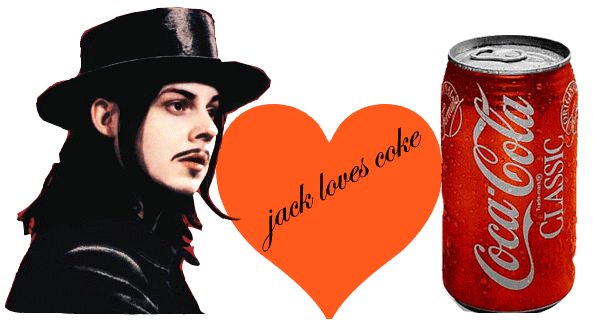
Jack and Coke


Indie icon and musical maverick Jack White has shocked many of his fans by recording a song for Coca-Cola. So has the flag-bearer of logo-free rock music really sold out?

“Do a commercial and you’re off the artistic roll-call forever. Every word you say is suspect. You are just another corporate whore at the capitalist gang bang.” Bill Hicks
“Madonna drinks Coke and so you can too, tastes real good not like a sweet poison should.” Manic Street Preachers
McDonalds had Justin Timberlake and Loving It. Now Coca-Cola has Jack White and Love is the Truth. McDonalds and Coca-Cola: two all-conquering multinationals synonymous with the dark side of capitalism. This is why the man who once rejected a deal to appear in a Gap advert has surprised so many of his fans by composing a song for the ‘sweet poison’ that is Coke.
The reason he has given for recording the song may surprise fans even more than hearing that The White Stripes front man had agreed to the deal. Jack has confessed that he loves Coke and this is why he agreed to write a song for one of their commercials. He loves it so much that he has declared it “the greatest drink ever made by man”. He is also a long term Coke fanatic, having reportedly written over 100 songs in celebration of the fizzy drink when he was a teenager.
Many have been quick to criticise the musician, but remember this is Jack White we are talking about here. He is a man who is dripping with mystery and a man who is, to say the least, unconventional. So unconventional in fact that he sees nothing wrong with writing a song for a drink that is a symbol of conformity?
It is not as if he has sold a song from his back catalogue for an advertisement, a la Moby. All 18 tracks of the vegan's 1999 album Play have featured in various commercials. The White Stripes singer defended his decision to record the song in an interview with N.M.E: "I've been offered the opportunity to write a song in a way which interests me as a songwriter. I certainly wouldn't want a song that I'd already written to be used on a commercial".
It has been pointed out that The White Stripes’ colours of red and white are the same colours as…you’ve guessed it. So was this bold tribute to simplicity really influenced by the colours of the most famous soft drink brand of all time? We may never know. But before some of his fans call for his head, we should give Jack White some leeway. Yes, he has written a song for a commercial, but it is for a drink that has reportedly had some influence in his life. So no Coke, no Jack, not as we know him, anyway.
So we will forgive him for now. But like the drink that he is singing about, it is still likely to leave a bitter-sweet taste in the mouths of his fans.

Monday, 8 May 2006

The Cult Of Bill Hicks

Twelve years after his death, Bill Hicks’ popularity continues to grow. With the recent releases of a DVD and a biography, interest in the late comedian has risen far beyond anything from when he was alive. Some of his fans even consider him as something of a prophet. So why is there such a fascination with a man who when he died was still relatively obscure? Welcome to the cult of Bill Hicks…
(Click here to download a printable version of this article)

“It’s great to be back here. Wherever the hell I am, I always have a great time when I’m here.”


This year has seen the release of Relentless, a DVD of one of his live shows, and Agent Of Evolution, a biography by his childhood friend Kevin Booth. These releases highlight the fascination with the controversial comedian that has continued to grow since his untimely death from pancreatic cancer in 1994 at the age of just 32.


“I have been a comedian for a long time, so forgive me while I plaster on a
fake smile and pile through this shit one more time.”
Hicks performed his first gig when he was 13; at 17 he was a regular performer at the Comedy Workshop in Houston, Texas, while he was still at high-school. He spent the 1980s touring across America, regularly performing more than 250 shows a year. In the late 80s he made regular appearances on Tonight With David Letterman before finding international success in the early 90s.


“I don’t do drugs anymore... than say the average touring funk band.”
This may seem like a normal career path for a comedian, but Bill Hicks was anything but a normal comedian. His views on abortion and attacks on pro-lifers caused his final performance on Letterman to be axed as it was felt that his material wouldn’t go down well with the shows sponsors.


“If you’re so pro-life, do me a favour: don’t lock arms and block medical
clinics. If you’re so pro-life, lock arms and block cemeteries.”
Abortion, the Gulf War, the L.A. Riots, religion, smoking, guns, drugs, and pornography: nothing was sacred as far as Hicks’ comedy was concerned.

“A lot of Christians wear crosses on their necks. Do you think that when Jesus
comes back he wants to see a fucking cross?”
His vitriolic critiques of American society meant that he never had massive success in the States, confining him to the small club circuit for over a decade. Hicks even named one of his tours ‘The Flying Saucer Tour’ as “like UFOs, I too will be appearing at small Southern towns”. However, his seemingly anti-American stance caused his popularity to soar when he toured Europe in the early 90s, playing to appreciative crowds, culminating in the career defining sold-out performance at the 2,000 seat Dominion Theatre in London, which was recorded for Channel 4 and is available on the Totally Bill Hicks DVD. As writer Eric Bogosian said of Hicks, “There’s this sort of tornado moving around the stage and cycling around and throwing all this energy at you”.

(Sarcastically)“There is no connection, and you would be a fool and a communist
to make one…between having a gun and shooting someone with it and not having a gun and not shooting someone with it.”

Hicks was arrogant and confrontational and this was certainly part of his appeal. People love an outsider, an angry young man, but with Hicks his performances were much more than stand-up comedy. Many fans have compared Hicks to a preacher, even a prophet, and it is clear when you watch his shows that he is a naturally gifted performer. Hicks sought enlightenment and wanted to awaken his audiences from what he saw as the hegemonic devices of capitalist America. As Hicks said, “As long as one person lives in darkness then it seems to be a responsibility to tell other people”.


“I smoke. If this bothers anyone, I recommend that you look around the world
that we live…and shut your fucking mouth.”
Despite his venomous attacks on American society, Hicks did not hate people; what he hated was the ways in which the government and multinational corporations had created an apathetic and docile society. He attacked manufactured pop stars, calling performers like Vanilia Ice “ball-less, soul-less suckers of Satan’s cock”. He labelled television as “Lucifer’s dream box” and said that watching it was “like spraying black spray paint into your third eye”. And he famously told people in marketing and advertising to “kill themselves”.

This may be the reason why Hicks popularity continues to grow after his death. The world we live in today is dominated by manufactured pop stars, barrel-scraping ‘reality’ television shows, and we are saturated by advertisements on a daily basis. As Tracy, a fan from the UK commented on an article that marked the 10th anniversary of his death:

“Bill Hicks comments on society are as relevant today as they were when he first spoke them…I believe he certainly provoked and challenged and that’s why he is remembered today.”


When you listen to his passionate critiques of the Gulf War, the comparisons between what he said about Bush Senior and the behaviour of Bush Junior a decade later are extremely poignant.

“A war is when two armies are fighting. So you see, right there, I think we can
all agree it wasn’t exactly a war.”
Maybe it is because people are more cynical today that Hicks’ humour is given such value. And it can be argued that this cynicism is a result of the post-9/11 world that we live in. For many fans watching a George W. Bush speech on the news, there is a longing for Hicks to be alive so that we could hear what he would have to say about the antics of Bush Junior. As Neil, a fan from Thailand states:

“It really is a shame that Hicks isn’t around to see how his targets have grown in influence. From Bush’s war and vested corporate interests to the religious right, all of them riper than ever to be on the receiving end of Hicks’ quick-fire wit and venom.”

Although much of his comedy is still relevant today, for some who are less passionate about his work, his continued popularity is seen as a result of his early death, what some would term the ‘Princess Diana syndrome’. UK comedy writer Tirmandra Harkness says that Hicks’ longevity is a result of “the fact that he died tragically young and therefore retains the seductive perfume of unfulfilled promise”.

“All our beliefs are being challenged now, and rightfully so – they’re stupid.”

Yes, some of Hicks' mystique does come from the fact that he died young. And as a result he has become canonised by some of his fans alongside great musicians such as Jim Morrison, Jimi Hendrix and Kurt Cobain who all died young. Some consider him a genius, some consider him as one of the greatest comedians ever. There certainly seems to be no-one as passionate or as controversial as Hicks around today. Chris Rock may come close, but he does not quite have the same sense of authority that Hicks had.

“I hate patriotism. I can’t stand it…It’s a round world last time I checked.”

That authority may be posthumous and yes, it is impossible to view Hicks' career objectively after his death. Nevertheless, it is a combination of his humour still being relevant today and his early death that causes the cult of Bill Hicks to continue to grow. For many fans there is a sense of sadness in the fact that he is not alive today to vent his anger at an increasingly fractured world, yet there is also relief in listening to a man passionately articulating the frustrations that many of us feel today. The fact that what he was saying is over a decade old but is still strikingly relevant is what causes Hicks’ reputation to continue to grow.

“We are the facilitators of our own evolution.”
However, it doesn’t matter if Bill Hicks is regarded as a genius or the greatest comedian ever: what matters is that like Jim Morrison, like Jimi Hendrix and like Kurt Cobain, Bill Hicks spirit lives on through the love of his fans. Hicks last words, read at his memorial by his brother, were:

“I left in love, in laughter, and in truth, and wherever truth, love and laughter abide, I am there in spirit.”

To his fans this will always remain true.

Want more Bill Hicks?Watch this: Totally Bill HicksRead this: Love All the PeopleListen to this: Rant in E-Minor